Criminal
How to Challenge or Quash an FIR in India: High Court Remedies under BNSS
Learn when and how the High Court can quash an FIR under Section 528 BNSS, including grounds, limits and procedure.
Read guide →
Bail, quashing, trial defence, NDPS, cheating, cyber-crime and white-collar offences before every court.

A criminal case begins when the State alleges that a person has committed an offence. The accused faces loss of liberty, so the law guards procedure closely: arrest must be lawful, custody is reviewed by a Magistrate, bail is the rule in most cases, the prosecution must prove guilt beyond reasonable doubt, and every conviction can be appealed. This pillar guide explains the framework, the key remedies (bail, anticipatory bail, quashing, discharge, appeal) and what to do in the first 48 hours. It links to our detailed articles on specific offences so that you can go deeper on your own issue.
AskAdvocates Law Chamber, Chennai, represents accused persons, complainants and victims before magistrate courts, sessions courts, the Madras High Court and the Supreme Court of India.
On 1 July 2024 three codes took effect and replaced colonial-era statutes for new offences:
| Subject | New law | Replaced |
|---|---|---|
| Offences and punishments | Bharatiya Nyaya Sanhita, 2023 (BNS) | Indian Penal Code, 1860 |
| Procedure, bail, trial, appeals | Bharatiya Nagarik Suraksha Sanhita, 2023 (BNSS) | Code of Criminal Procedure, 1973 |
| Evidence | Bharatiya Sakshya Adhiniyam, 2023 (BSA) | Indian Evidence Act, 1872 |
Cases for offences committed before 1 July 2024 continue under the old codes, which is why you will still see IPC and CrPC citations in pending matters. Special statutes run alongside the codes: the NDPS Act, 1985, the POCSO Act, 2012, the Prevention of Corruption Act, 1988, the Negotiable Instruments Act, 1881 (Section 138 cheque dishonour), the Information Technology Act, 2000, the Prevention of Money Laundering Act, 2002, the Protection of Women from Domestic Violence Act, 2005 and the Arms Act, 1959. Each has its own bail thresholds, presumptions and special courts.
Understanding the category of an offence decides almost everything about the case:
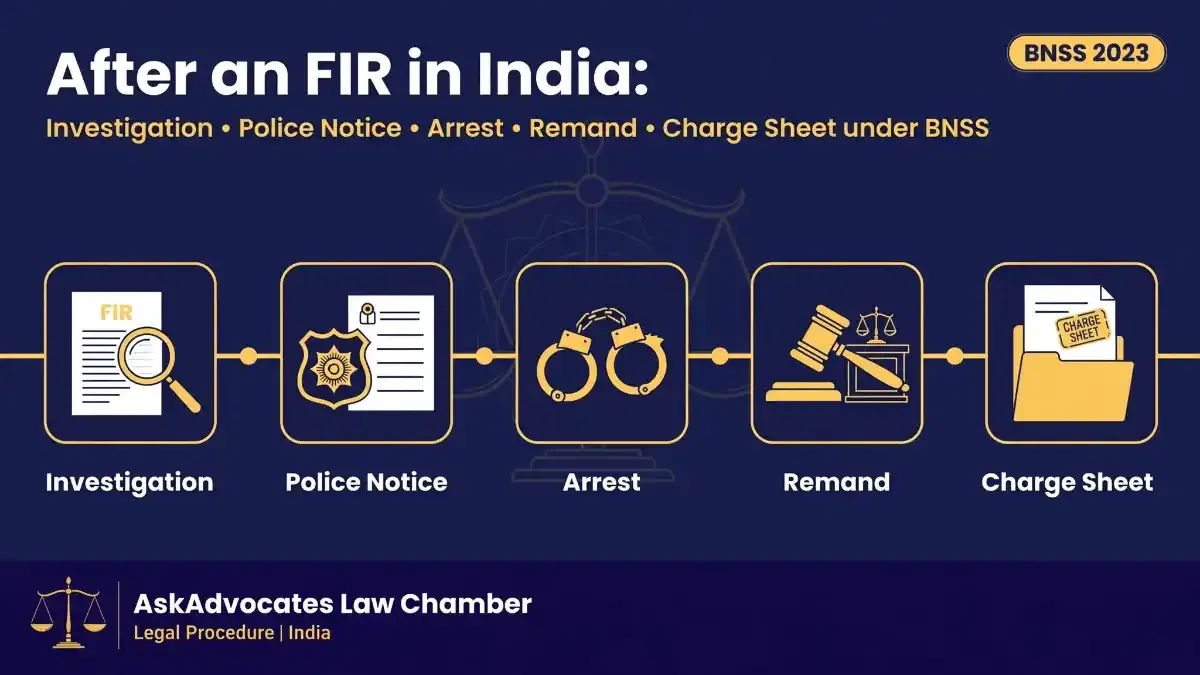
An FIR may be lodged at any police station irrespective of territorial jurisdiction (the “Zero FIR” concept), and Section 173 BNSS permits electronic information. For certain offences punishable with three to seven years, a preliminary enquiry may be held within fourteen days. A copy of the FIR must be supplied to the informant free of cost.
The police may call you for questioning, record statements and seize material. Remember:
If the police refuse to register an FIR for a cognizable offence, the remedy is to approach the Superintendent of Police and then the Magistrate (Section 173(4) BNSS) or the High Court by way of writ.
Arrest must be effected only when necessary. The grounds must be communicated, a relative or friend must be informed and the person must be medically examined. The Supreme Court’s guidelines in D.K. Basu v. State of West Bengal (1997) remain the baseline, and Arnesh Kumar (2014) and Satender Kumar Antil v. CBI (2022) discourage routine arrests for offences punishable up to seven years.
Within 24 hours of arrest the person must be produced before a Magistrate, who decides whether to remand to police or judicial custody. The Magistrate cannot authorise custody mechanically. Defence counsel should oppose remand with the specific illegalities (no grounds communicated, delay, non-compliance with notice procedure) and press for bail immediately.
Regular bail is applied for after arrest. Courts consider the nature and gravity of the accusation, the severity of punishment, the likelihood of the accused absconding or influencing witnesses, previous criminal history and the period of custody already undergone. Long incarceration without trial, medical grounds, age, gender and parity with co-accused weigh in favour of bail.
Anticipatory bail under Section 482 BNSS protects a person who apprehends arrest. The High Court or Court of Session may grant it with conditions such as cooperation with the investigation, surrender of passport and not leaving the jurisdiction. The Supreme Court in Sushila Aggarwal v. State (NCT of Delhi) (2020) held that anticipatory bail need not be time-limited. Read our detailed guide on anticipatory bail.
Default (statutory) bail arises under Section 187 BNSS when the police fail to file the charge-sheet within 60 days (offences punishable up to ten years) or 90 days (offences punishable with death, life or ten years or more). The right is indefeasible once the accused files the application before the charge-sheet is filed.
Special bail regimes stricter conditions apply in NDPS cases (Section 37), UAPA, PMLA (Section 45 twin conditions, upheld in Vijay Madanlal Choudhary v. Union of India (2022)) and POCSO cases. See also our guide to NDPS cases, bail and trial.
| Remedy | When | Forum | Key point |
|---|---|---|---|
| Anticipatory bail | Before arrest | Sessions Court / High Court | Conditions, cooperation with police |
| Regular bail | After arrest | Magistrate, Sessions, High Court | Discretion, parity, custody period |
| Default bail | Charge-sheet delayed | Magistrate | Right accrues at 60/90 days |
| Interim bail | Short relief pending hearing | Any competent court | Medical, urgent personal grounds |
| Bail on appeal / suspension of sentence | After conviction | Appellate court | Section 430 BNSS |
The High Court’s inherent jurisdiction under Section 528 BNSS (earlier Section 482 CrPC) lets it quash proceedings in rare cases. Guiding principles from State of Haryana v. Bhajan Lal (1992) include allegations that, even if taken at face value, make out no offence; allegations manifestly absurd or inherently improbable; a legal bar to proceedings; and proceedings maliciously instituted with an ulterior motive. In Gian Singh v. State of Punjab (2012) and Narinder Singh (2014), the Supreme Court recognised quashing on the basis of settlement in predominantly private or civil-flavoured disputes (for example, matrimonial or commercial matters), though not in heinous offences such as murder or rape.
A quashing petition needs a well-organised paper-book: FIR, complaint, charge-sheet if filed, relevant contracts or correspondence, and any settlement deed. For a deeper discussion see how to quash an FIR under BNSS.
Cheating (Section 318 BNS), criminal breach of trust (Section 316), forgery (Sections 336 to 340), cheque dishonour (Section 138 NI Act), bank fraud, GST evasion, money-laundering and corruption offences form a growing share of our practice. Common features are document-heavy evidence, parallel civil and criminal proceedings, summons from the Enforcement Directorate or CBI and the need to protect assets and reputation. Read more on cheating cases and the procedure in a cheque bounce case.
The Chamber acts for both survivors and accused in cases under the BNS provisions on cruelty by husband or relatives (Section 85/86), dowry death (Section 80), sexual offences (Sections 63 to 71), and the POCSO Act. Courts insist on prompt, sensitive procedure: statements of the survivor are recorded before a Magistrate, identity is protected, and trials are in-camera. For accused persons, a careful review of delay, contradictions, medical evidence and the possibility of false implication is essential. See our guides on dowry cases and domestic violence cases.
Trial strategy turns on cross-examination, admissibility of confessions and recoveries, chain of custody, forensic reports and contradictions between the FIR, the section 180 statements and court testimony.
A convicted person may appeal to the Sessions Court (from Magistrate convictions), the High Court (from Sessions convictions) and the Supreme Court. The State may appeal against acquittals with leave. The appellate court can suspend the sentence and grant bail during the appeal. Revision lies against interlocutory or illegal orders. Further, special leave petitions under Article 136 of the Constitution reach the Supreme Court. Plan the limitation: appeals generally must be filed within 30 or 60 days under the Limitation Act schedules and BNSS.
Scenario 1: a business partnership dispute turns into an FIR. A supplier alleges cheating over unpaid invoices. The allegations show a commercial relationship with no dishonest intention at inception. Counsel files a petition to quash the FIR with the contract and payment trail, relying on the principle that a breach of contract does not by itself amount to cheating. The High Court may stay coercive steps pending hearing.
Scenario 2: a matrimonial dispute with dowry allegations. A husband and his elderly parents are named. Counsel seeks anticipatory bail, highlights omnibus allegations and delay, and, where genuine settlement occurs, applies for quashing or mediation. Meanwhile, the wife’s remedies for maintenance and residence proceed separately.
Scenario 3: arrest in a cheque dishonour case. Section 138 NI Act is a bailable offence; the accused applies for bail on appearance, pursues compounding under Section 147 and complies with interim compensation directions under Section 143A.
Our team is reachable by phone, WhatsApp, SMS and email through the buttons on every page. You can also read our wider legal insights on criminal procedure.
This guide is for general information under Indian law as at November 2026 and is not legal advice. Please consult an advocate on your facts.
Offences committed on or after 1 July 2024 are governed by the Bharatiya Nyaya Sanhita, 2023, the Bharatiya Nagarik Suraksha Sanhita, 2023 and the Bharatiya Sakshya Adhiniyam, 2023. Offences committed earlier continue to be tried under the Indian Penal Code, the Code of Criminal Procedure, 1973 and the Indian Evidence Act, 1872.
Anticipatory bail is sought before arrest from the Court of Session or High Court when you fear arrest in a non-bailable offence (Section 482 BNSS, earlier Section 438 CrPC). Regular bail is sought after arrest or custody, from the Magistrate, Sessions Court or High Court (Sections 478 to 483 BNSS).
Yes. Section 528 BNSS (earlier Section 482 CrPC) preserves the High Court's inherent power to quash an FIR or proceedings to prevent abuse of process or to secure the ends of justice, for example where the allegations disclose no offence or a dispute is essentially civil or has been settled in a compoundable or private matter.
No. Arrest is a power, not a duty. For offences punishable with up to seven years, the police must record reasons and follow the notice-of-appearance procedure (Section 35 BNSS, earlier Section 41A CrPC) as explained in Arnesh Kumar v. State of Bihar (2014).
A person arrested must be produced before a Magistrate within 24 hours, excluding travel time (Article 22 of the Constitution and Section 58 BNSS). Further police custody is limited, and default bail arises if the investigation is not completed within 60 or 90 days, depending on the offence (Section 187 BNSS).
You have a constitutional right to consult and be defended by an advocate of your choice (Article 22(1)), and Section 38 BNSS allows you to meet your advocate during interrogation. Do not sign blank papers or statements without advice.
Learn when and how the High Court can quash an FIR under Section 528 BNSS, including grounds, limits and procedure.
Read guide →Introduction: An FIR is not the end of a criminal case. It is generally the beginning of the formal criminal investigation process. First, after…
Read guide →Introduction: Yes — every person arrested in India, regardless of the offence, has a defined set of rights under the Constitution and the…
Read guide →Proven Track Record in Criminal Defense - Criminal defense safeguards constitutional rights from investigation through trial and appeal. Moreover,…
Read guide →Trusted Criminal Defense Lawyers - Criminal allegations demand immediate legal guidance because every procedural step affects future rights. Ask…
Read guide →Aggressive Legal Defense - Facing criminal allegations creates immediate legal risks, financial pressure, and personal uncertainty. Ask Advocates…
Read guide →Assertive Defense Strategies - Criminal allegations can affect liberty, reputation, employment, and family life. Therefore, immediate legal…
Read guide →Embark on a journey into the heart of legal advocacy as we delve into the realm of Criminal Defense in Chennai. In this exploration, we unravel…
Read guide →Are you firstly entangled in legal complexities that demand the expertise of seasoned Experienced advocates in Chennai? Look no further, for your…
Read guide →When it comes to legal matters, the importance of quality legal services cannot be overstated. People often find themselves in situations that…
Read guide →Advocate Saravvanan Rajendran Law Chamber is one of the Best Law Firms in Chennai, India. Firstly, The Team of Top Lawyers for Litigation Support…
Read guide →How can you resolve the criminal matters? Of course, you can choose a Reliable Attorney for criminal cases from the Top 10 Criminal Lawyers in…
Read guide →Advocate Saravvanan Rajendran Law Chamber is one of the Best Law Firm in Chennai, India. The Team of Top Lawyers for the Protection of Children…
Read guide →Top CRIMINAL CONSPIRACY Advocates in Chennai India Search the Best Advocates for Criminal Conspiracy litigation in Chennai, Tamil Nadu, India.…
Read guide →Find the Best Advocates for Juvenile Crime law in Chennai. ADVOCATES FOR JUVENILE CRIME LAW Juvenile crime lawyers in Advocate Saravvanan…
Read guide →International law advocates in Chennai for International trade and finance law. Search Lawyers in Chennai from leading Law Firms in India for…
Read guide →The best advocates to guide you through your legal disputes by a general legal opinion for Civil, Criminal, Corporate, service matters & Family issues
Read guide →ADVOCATES FOR FRAUD CASES IN CHENNAI at our Corporate Law firm represent individuals & business organizations across a wide array of fraud cases.
Read guide →Are you in a Charge of Drug Crime in Chennai. Find the Best NDPS Advocates in India. ADVOCATES FOR DRUG CRIME CASES IN CHENNAI Are you facing a…
Read guide →Top Criminal defense advocates in Chennai high court from leading law firm, Advocate Saravvanan Rajendran law associates aim to quash all your…
Read guide →Criminal legal opinion Lawyers in Chennai high court. Ask Advocates Vakils & Senior Counsels of a leading Law Firm in Tamilnadu India
Read guide →Find the Best Criminal Advocates in Chennai for Bribery Issues in Chennai. Advocate Saravvanan Rajendran Law Chambers is a Group of Vakils for…
Read guide →Anticipatory Bail Service advocates in Chennai, Find the best criminal lawyers in Chennai high court. & Senior Counsels of Top Law Firm in Tn
Read guide →Leading Criminal Advocates in Chennai for Unlawful Activities Prevention Act,UAPA Lawyers in Madras high court. Contact +91-9994287060 Top Law…
Read guide → Bar Council of India · Disclaimer
The Bar Council of India does not permit advertisement or solicitation by advocates in any form or manner (Rule 36, Bar Council of India Rules). By clicking “I Agree”, you acknowledge and confirm that:
If you do not agree, please do not use this website.
You have declined. You may close this window; no content will be shown until you agree.