Civil
Temporary Injunction in India: When Can a Court Restrain the Other Party?
Learn when Indian courts grant temporary injunctions, three tests, Order 39 procedure, evidence, ex parte relief and appeals.
Read guide →
Suits, injunctions, recovery, specific performance, partition and appeals in civil courts and the High Court.

Civil litigation resolves private disputes: unpaid money, contracts, property, injunctions, partition, damages and declarations of rights. The process is rule-bound and time-limited. Most disputes are won or lost on three things: the strength of documents, the correct choice of forum and cause of action, and compliance with limitation. This guide maps the full life of a civil case so that you can plan before you file or defend.
AskAdvocates Law Chamber handles civil suits and appeals before the civil courts in Chennai, the City Civil Court, district and subordinate courts across Tamil Nadu, the Madras High Court and the Supreme Court of India.
| Proceeding | Purpose | Typical relief |
|---|---|---|
| Money recovery suit | Recover debt, price of goods, loan | Decree for money with interest and costs |
| Summary suit (Order 37) | Quick recovery on bills, cheques, written contracts | Judgment unless leave to defend granted |
| Specific performance | Compel performance of an agreement | Direction to execute sale deed, damages in lieu |
| Injunction suit | Restrain wrongful act | Temporary and permanent injunction |
| Declaration suit | Establish title or status | Declaration under Section 34 Specific Relief Act |
| Partition suit | Divide joint family or co-owned property | Preliminary and final decree |
| Possession and eviction | Recover property from trespasser or tenant | Possession, mesne profits |
| Damages / tort | Compensate for wrongful injury | Compensation |
Good litigation starts months before filing. Gather the originals of every relevant document, check stamp duty and registration, build a dated chronology and send a legal notice that states facts and demands, as the notice can later demonstrate reasonable conduct and trigger interest or costs. In certain cases a notice is mandatory, for example against the government under Section 80 CPC (two months’ notice before suing the Government or a public officer for acts in official capacity) and in cases under special statutes.
Confirm your cause of action and limitation. Note that acknowledgement in writing (Section 18) and part-payment (Section 19) can extend limitation, but only if made within the period and signed.
Under Sections 15 to 20 CPC, a suit is instituted in the court of the lowest grade competent to try it. Jurisdiction has three components:
Court fee is payable on the claim value, and under-valuation can lead to rejection of the plaint. The choice between a plaint for a declaration with consequential relief and a bare injunction suit must be made carefully, as in title disputes a bare injunction without a declaration is vulnerable when title is seriously disputed.
The plaint (Order 7) states the parties, facts constituting the cause of action, jurisdiction, valuation, limitation and the reliefs. It must be supported by documents. The written statement (Order 8) must be filed within 30 days of service and not later than 90 days. For commercial suits, the 120-day outer limit applies. A defendant must deal specifically with each allegation, as admissions can be taken as proved. A counter-claim may be raised against the plaintiff, and set-off for ascertained sums.
Common defences include limitation, lack of jurisdiction, absence of cause of action, non-joinder or mis-joinder of parties, payment or discharge, fraud and lack of consideration. Applications to reject the plaint (Order 7 Rule 11) can end baseless suits at the threshold.
Interim orders often decide the real outcome. Under Order 39 Rules 1 and 2, the court grants temporary injunctions where the applicant shows a prima facie case, balance of convenience and irreparable injury. Other interim tools:
Full disclosure is essential. Suppression of material facts can lead to vacating of interim orders and costs.
After pleadings, the court frames issues (Order 14), which are the questions to be decided, and the burden of proof is assigned. Parties file documents with a list; originals are produced or proved by witnesses. Evidence-in-chief is by affidavit (Order 18 Rule 4), followed by oral cross-examination. Expert evidence, handwriting comparison and local inspection may be sought. Careful cross-examination is often the most decisive stage.
Commercial courts follow a case-management hearing and a time-bound schedule. Summary judgment (Order 13A) is available if the defendant has no real prospect of defending.
The court pronounces judgment and a decree is drawn up. Interest (Section 34 CPC) and costs (Section 35) are discretionary but significant, and in commercial matters costs follow the event under Section 35 as amended. In partition and mortgage suits, preliminary and final decrees are separate.
| Remedy | Provision | Time limit | Notes |
|---|---|---|---|
| First appeal | Section 96 CPC | 30 days (District Court) / 90 days (High Court) | Appeal on facts and law |
| Second appeal | Section 100 CPC | 90 days | Only on substantial question of law |
| Review | Order 47 | 30 days | Error apparent on the face of record |
| Revision | Section 115 CPC | 90 days | Jurisdictional errors only |
| SLP to Supreme Court | Article 136 | 90 days | Special leave |
| Appeal in commercial matters | Section 13 Commercial Courts Act | 60 days | Orders listed in Order 43 CPC |
Condonation of delay under Section 5 of the Limitation Act is available for appeals but not for suits, and must be backed by a sufficient cause with day-by-day explanation. Stay of execution can be sought along with the appeal under Order 41 Rule 5.
A decree is of no practical value unless executed. Under Order 21, the decree-holder may seek attachment and sale of the judgment-debtor’s property, garnishee orders for debts owed to the judgment-debtor, arrest and detention in civil prison in limited cases, and delivery of possession of immovable property. In Rahul S. Shah v. Jinendra Kumar Gandhi (2021), the Supreme Court issued directions to expedite execution and disposal of execution petitions. Execution should be filed within twelve years of the decree.
Many civil disputes settle faster outside court. Section 89 CPC empowers the court to refer parties to arbitration, conciliation, mediation, Lok Adalat or judicial settlement. The Mediation Act, 2023 allows enforceable mediated settlement agreements, and a Lok Adalat award under the Legal Services Authorities Act, 1987 is deemed a decree of a civil court and is final. Where an arbitration clause exists, Section 8 of the Arbitration and Conciliation Act, 1996 requires the court to refer the parties to arbitration if raised timely. See our pillar guide on arbitration and dispute resolution.
After the 2018 amendment, specific performance of a contract is no longer a discretionary remedy of last resort, so courts must enforce contracts unless statutory exceptions apply. The plaintiff must plead and prove readiness and willingness to perform (Section 16(c)) throughout. Courts are also required to dispose of such suits within twelve months, extendable by six months. Read our detailed article on specific performance of contracts in India.
Recovery of a business loan. A trader lent Rs 12 lakh against a promissory note. After a notice, the borrower does not pay. A summary suit under Order 37 is filed, the defendant seeks leave to defend, and the court grants conditional leave with deposit of the suit amount if the defence appears weak. Interest and costs follow in the decree.
Encroachment on a family plot. A neighbour builds a wall on part of an inherited plot. The owner files a suit for declaration of title and permanent injunction, applies for a temporary injunction and seeks an advocate commissioner to measure the land. Survey sketches and the revenue records are tested in evidence.
Builder delays handing over. Where the buyer wants the flat, specific performance with compensation under Section 21 can be sought, while remedies under RERA and consumer law may run in parallel with a carefully chosen forum.
AskAdvocates Law Chamber assists with notices, plaints and written statements, interim applications, trial and cross-examination, execution, appeals and settlement. For property disputes, also read our pillar on property and real estate law, and browse more in legal insights.
This guide is general information under Indian law as at November 2026 and not legal advice.
It depends on the cause of action under the Limitation Act, 1963. A suit for recovery on a written contract or money lent is generally three years, a suit for possession of immovable property based on title is twelve years, and a suit for specific performance is three years from the date fixed for performance or from when the plaintiff has notice of refusal.
Choose the court by subject matter, pecuniary value and territory (Sections 15 to 20 CPC). Suits relating to immovable property are filed where the property lies, and other suits where the defendant resides or the cause of action arose. Commercial disputes above the specified value go to commercial courts under the Commercial Courts Act, 2015.
A temporary injunction under Order 39 Rules 1 and 2 CPC is an interim order restraining a party from an act, such as selling or disturbing possession of a property, until the suit is decided. The applicant must show a prima facie case, balance of convenience and irreparable injury.
For commercial suits that do not contemplate urgent interim relief, Section 12A of the Commercial Courts Act, 2015 requires pre-institution mediation. Non-compliance leads to rejection of the plaint.
Timelines vary by court and complexity. Simple recovery suits may conclude within two to four years, while contested title suits can take longer. Summary suits under Order 37 CPC and commercial courts follow stricter timetables.
Yes. A decree-holder files an execution petition under Order 21 CPC to attach and sell property, arrest the judgment-debtor in limited cases or obtain delivery of possession. The Supreme Court has directed courts to dispose of execution petitions expeditiously.
Learn when Indian courts grant temporary injunctions, three tests, Order 39 procedure, evidence, ex parte relief and appeals.
Read guide →Learn how to choose the right civil remedy, court, jurisdiction, limitation strategy and evidence for civil litigation in India.
Read guide →Modern corporate operations must navigate dense regulatory networks governed by municipal, state, and central authorities. Unanticipated…
Read guide →Introduction Government regulations affect property, licences, businesses, employment, taxation, public services, and civic rights. Administrative…
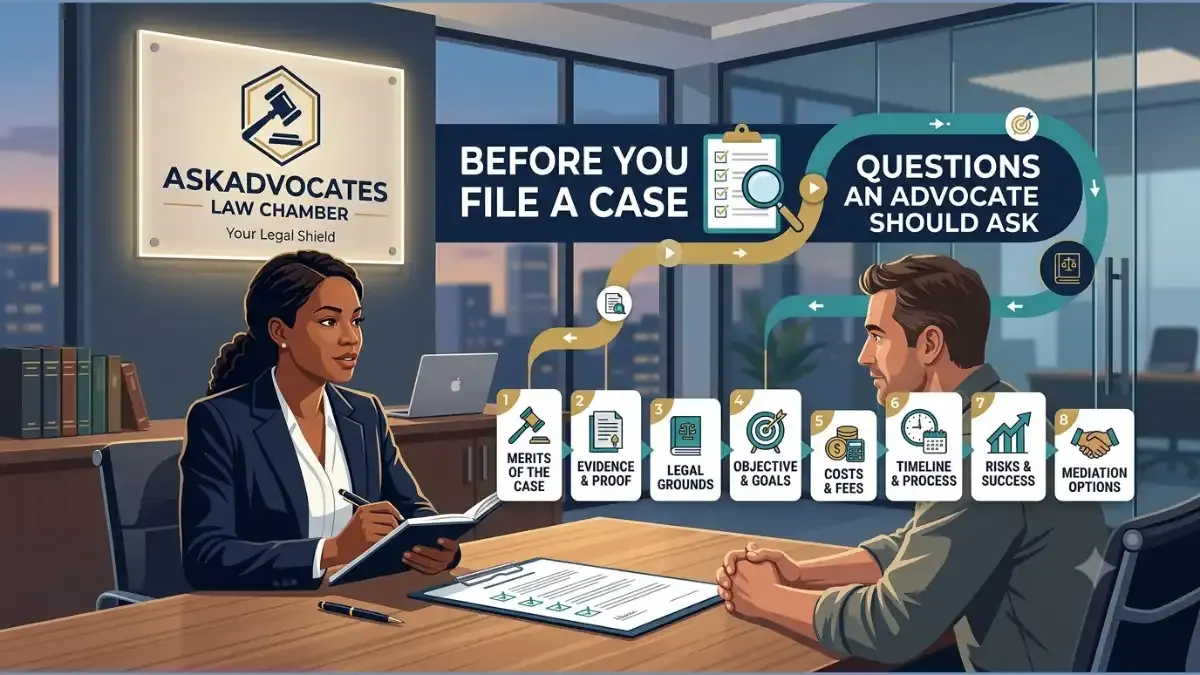
Read guide →Before filing a case, an advocate should assess facts, evidence, parties, jurisdiction, limitation, remedies, risks and alternatives. Practical…
Read guide →National Trust Act, a cornerstone of Indian estate planning, offers families a powerful tool to preserve their ancestral property and ensure its…
Read guide →The vast expanse of the ocean facilitates global trade, but it can also be a stage for complex legal disputes. When disagreements arise on the…
Read guide →Find expert Advocates near me in Chennai at Ask Advocates Law Chamber. Trusted allies in personal injury, criminal defense, business disputes
Read guide →Looking for civil litigation advocates in Chennai? AskAdvocates Law Chamber is a leading law firm specializing in civil litigation. Contact us for…
Read guide →In the labyrinthine world of legal affairs, finding the right guidance can be akin to searching for a needle in a haystack. When confronted with…
Read guide →In the Driver's Seat: How Expert Attorneys Can Secure Your Motor Vehicle Accident Case. Avail Rajendra Legal Consultancy & Litigation Services.…
Read guide →Introduction When faced with legal issues, seeking expert legal advice becomes crucial to ensure the best possible outcome. Professional advocates…
Read guide →In a city as bustling and diverse as Chennai, the need for competent legal advocates cannot be overstated. Whether you find yourself in the midst…
Read guide →What is the Right to Freedom ? Freedom is not the right to do what we want, it is doing what we ought- Abraham Lincoln Why is the right to freedom…
Read guide → Bar Council of India · Disclaimer
The Bar Council of India does not permit advertisement or solicitation by advocates in any form or manner (Rule 36, Bar Council of India Rules). By clicking “I Agree”, you acknowledge and confirm that:
If you do not agree, please do not use this website.
You have declined. You may close this window; no content will be shown until you agree.