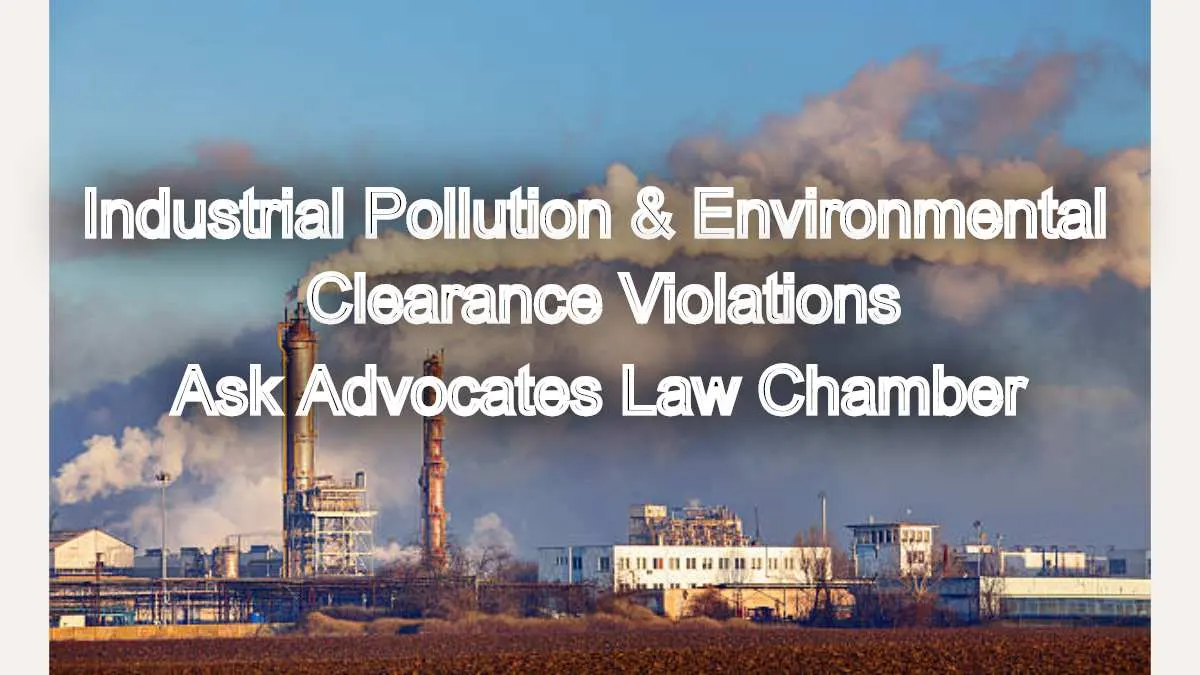
Industrial Pollution & Environmental Clearance Violations: Industrial pollution presents a serious threat to our environment. Accordingly, strict legal frameworks are necessary to protect our natural resources. The National Green Tribunal (NGT) is a specialized judicial body established to handle such complex environmental issues. This guide will provide an overview of industrial pollution, environmental clearance violations, and the legal procedures involved in NGT proceedings.
Industrial Pollution and Environmental Clearance Violations: A Guide to NGT Proceedings: Ask Advocates Law Chamber
The Mandate of Environmental Clearance
Firstly, we must understand the concept of environmental clearance (EC). An EC is a mandatory legal approval that specific industrial and developmental projects must obtain before they begin operations. This is a precondition for development, which ensures that a project will not cause significant and irreversible environmental harm.
The Environment Impact Assessment (EIA) process is the primary mechanism for obtaining an EC. During an EIA, a project proponent studies and predicts the potential environmental, social, and economic impacts of their project. Moreover, they propose mitigation measures to minimize these impacts. The central idea here is to balance economic development with environmental protection, thus upholding the principle of sustainable development.
Addressing Industrial Pollution
Industrial pollution occurs when industries discharge waste and harmful substances into the air, water, and soil. This pollution can take many forms, including toxic effluents, hazardous waste, and harmful air emissions. As a result, it damages ecosystems, harms public health, and degrades natural resources.
Environmental laws like the Water (Prevention and Control of Pollution) Act, 1974, and the Air (Prevention and Control of Pollution) Act, 1981, set standards for industrial discharges and emissions. The Environment (Protection) Act, 1986 serves as an umbrella legislation, granting the government extensive powers to regulate pollution and establish environmental standards. Therefore, any industry that violates these standards is subject to legal action and penalties.
The National Green Tribunal: A Specialized Forum
In 2010, the NGT was established under the National Green Tribunal Act, 2010. It was created to provide a dedicated and specialized forum for the "effective and expeditious disposal of cases relating to environmental protection." The NGT's jurisdiction extends to all civil cases where a substantial question relating to the environment arises.
Consequently, the NGT has the authority to hear disputes involving violations of several key environmental laws. It is guided by principles of natural justice and is not bound by the strict procedures of the Code of Civil Procedure or the Indian Evidence Act. The NGT's unique composition, which includes both judicial and expert members, ensures that its judgments are based on sound legal reasoning and scientific expertise.
Violations and the Path to Legal Action
A violation of an EC occurs when an industry starts a project without obtaining the necessary clearance, or when it operates in breach of the conditions stipulated in the clearance. Furthermore, an industry can be held liable for pollution if it fails to comply with the standards set by the Central or State Pollution Control Boards.
The NGT can take up cases based on an application filed by any person or organization. In some instances, the Tribunal may also take suo motu action, meaning it can initiate proceedings on its own motion if a matter of significant environmental harm comes to its attention.
The NGT Proceedings Explained
Initially, a person or group that is aggrieved by a violation files an application with the NGT. This application must clearly state the facts of the case, the laws that have been violated, and the relief being sought. Subsequently, the NGT will issue a notice to the respondent, which is typically the polluting industry or the government authority responsible for regulation.
Afterward, the respondent must file a reply, and both parties present their evidence and arguments. The NGT may also appoint a committee of experts to conduct a site visit and submit a factual report. This is a crucial step since it provides the Tribunal with an independent assessment of the environmental damage. Finally, after hearing all parties and considering the evidence, the Tribunal delivers its judgment.
The Power of NGT Orders
The NGT has wide-ranging powers to issue orders and provide relief. In cases of environmental damage, the Tribunal can order the polluter to pay compensation to the victims and to the state for the cost of environmental restoration. This is based on the polluter pays principle, a fundamental tenet of environmental law that holds polluters financially responsible for the damage they cause.
Additionally, the NGT can impose heavy fines on companies that violate environmental norms. It can also issue directions for the closure of a polluting industry or for the demolition of illegal structures. Therefore, the orders of the NGT are legally binding and enforceable, and they serve as a powerful deterrent against environmental misconduct.
The Role of Legal Counsel
Navigating the complexities of NGT proceedings requires specialized legal expertise. A law firm like Ask Advocates Law Chamber can provide crucial assistance. A lawyer can help in drafting the application, gathering evidence, and representing the case before the Tribunal. Moreover, they can advise on the technical and scientific aspects of the case, ensuring that all legal requirements are met. The lawyer also plays a key role in negotiating with the opposing party and in seeking appropriate remedies. In a dispute involving industrial pollution, having a strong legal advocate is indispensable for achieving a just outcome.
Industrial Pollution & NGT: Frequently Asked Questions
The NGT is a specialized court in India designed to handle environmental cases quickly and effectively. It provides a legal platform for individuals and organizations to file complaints against industries that cause pollution or violate environmental laws. The NGT can order polluting industries to stop operations, pay fines, and provide compensation to affected parties.
An environmental clearance is a mandatory approval that certain projects must get from the government before they start. It's important because it ensures that a project's potential environmental impact is assessed beforehand. This helps in preventing pollution and environmental damage, making sure that development is sustainable and doesn't harm nature or people.
Anyone who is directly affected by industrial pollution or a violation of environmental law can file a case. This includes individuals, groups of people, and environmental organizations. The NGT's purpose is to be accessible to the public, giving a voice to those who are suffering from environmental harm.
The NGT has the power to impose various penalties. It can order a company to pay a fine for the environmental damage caused, often based on the "polluter pays principle." It can also direct a company to stop its activities, pay compensation to victims, and take steps to restore the damaged environment.
The polluter pays principle is a core concept in environmental law. It means that the party responsible for causing pollution or environmental damage should bear the costs of managing it and cleaning it up. The NGT frequently uses this principle to ensure that companies are financially responsible for the harm they create, rather than the public or the government.
Conclusion
In conclusion, the National Green Tribunal is a vital institution for enforcing environmental law in India. It provides an accessible and effective legal recourse for individuals and communities affected by industrial pollution and environmental clearance violations. The NGT's process, while specialized, is designed to ensure swift and fair justice. Consequently, by understanding the powers of the NGT and the legal procedures involved, we can hold industries accountable and work toward a cleaner, healthier environment.
Read More
- Suspension of Government Servants: CAT Case Strategies That Work
- How NGT is Shaping Chennai’s Lakes, Marshlands, and Coastal Projects
- What to Do When a Bank Files a Case in DRT? Your Legal Options
- Director Disqualification under Section 164 of Companies Act: NCLT Remedies
- Customs Tariff Rate Conflicts with Authorities? Legal Steps You Can Take Now
- National Green Tribunal (NGT):